ELISA and ECL Capabilities at VelaLabs
ELISA and ECL services at VelaLabs
At VelaLabs, we use a variety of technologies, including ELISA and ECL, to deliver precise and reliable protein binding results in multiple biological matrices including serum or plasma.
Our ELISA and ECL services cover a wide range of applications, including:
- Binding potency: Quantitative evaluation of sample activity by comparison to a reference. The detected signal is directly proportional to the amount of bound sample analyte. Confirmation assay for Cell-based assays (see Protein Expression and neutralizing antibodies).
- Competition ELISA: Determination of the analyte (antigen) concentration present in the tested sample by measuring the amount of sample antigen able to compete with a labelled or plate-bound antigen for a limited amount of specific antibody. The detected signal is inverse proportional to the amount of bound sample analyte.
- Anti-Drug antibodies: Determining the amount of drug binding antibodies present after drug treatment. Confirmation assay for Cell-based assays (see Protein Expression and neutralizing antibodies).
- Pharmacokinetics: Determining the concentration of a drug or biologic in biological matrix over time, enabling calculation of pharmacokinetic parameters such as absorption, distribution, metabolism and elimination
- Toxicokinetic: Determining the concentration of a toxic substance in biological matrix over time, enabling calculation of pharmacokinetic parameters such as absorption, distribution, metabolism and elimination
Our experts at VelaLabs are ready to develop and establish ELISA- and ECL-based assays according to national and international guidelines tailored for your needs.
Find out more about:
Working principles of ELISA and ECL
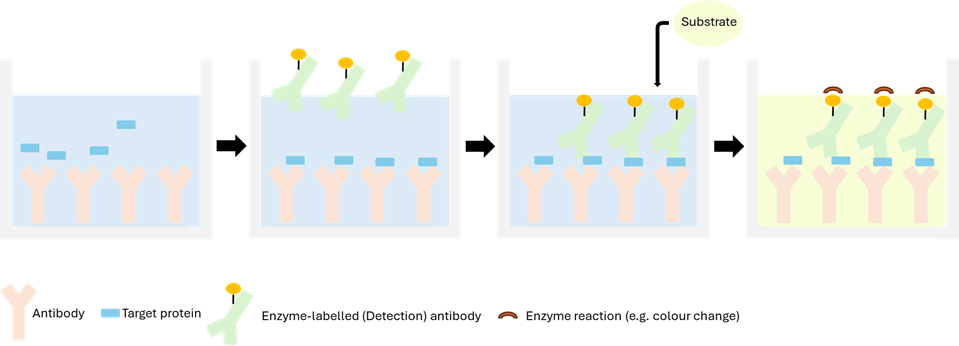
Enzyme-Linked Immunosorbent Assay (ELISA) is based on the specific binding between an antigen and an antibody, where one component is immobilized on a solid surface and the other is detected using an enzyme-linked antibody. Upon addition of a suitable substrate, the enzyme catalyses a reaction that produces a measurable signal (usually a colour change), the intensity of which is proportional to the amount of target analyte present.
Electrochemiluminescence (ECL) is based on the generation of light through electrochemically stimulated reactions, in which a labelled molecule containing a luminescent tag emits light upon excitation at an electrode surface. When a target analyte forms a complex with specific binding partners (e.g., antigen–antibody), the label is brought to the electrode, where an applied voltage triggers a chemical reaction that produces light; the emitted signal is measured and is proportional to the amount of analyte present.
Comparison ELISA and ECL
The overall sensitivity of ELISA- and ECL-based immunoassays differ greatly due to fundamental differences in signal generation and detection mechanisms.
ELISA relies on enzyme-mediated conversion of a substrate into a measurable colorimetric, fluorescent or chemiluminescent signal. This allows ELISA to achieve limits of detection in the nanogram per milliliter range, with optimized chemiluminescent assays occasionally being able to detect even picogram of analyte. In contrast, ECL‑based assays utilize electrochemically stimulated luminescent labels, such as ruthenium complexes, which emit photons upon redox cycling at an electrode surface producing a measurable light signal. This mechanism enables development of methods with detection limits in the low picogram per milliliter range making ECL more suitable for the detection of low-abundance analytes.
This superior sensitivity of ECL assay is largely attributed to their enhanced signal‑to‑noise ratio. In general ELISA, background signal can arise from non-specific adsorption, incomplete washing between incubation steps and variability in enzyme kinetics, all which contribute to a reduction in analytical sensitivity. By comparison, ECL signal generation is mostly confined to the electrode surface of the assay plate and only occurs upon application of a defined electrochemical reaction, therefore minimizing background and improving signal quality. ECL assays also allow for measurements in a broader dynamic range, typically spanning four to six orders of magnitude, whereas ELISA is in general limited to a range of two to three orders of magnitude allowing for a more accurate quantification across a wider spectrum of analyte concentrations without the need for extensive sample dilutions. This superior sensitivity also allows for a reduction of the necessary amount of test sample. While ELISA usually requires a minimal volume of 50 – 100 µL per well, ECL can work with volumes as low as 10 µL per well.
ECL-based methods also offer improved reproducibility as environmental conditions such as temperature, pH or substrate stability only have minor influence on the generated signal, whereas ELISA shows increased sensitivity to such factors. Furthermore, ECL assays generally involve fewer steps, further reducing potential variability.
Additionally, while ELISA is generally restricted to measuring one analyte per well, ECL may be developed to detect multiple targets simultaneously in the same sample.
However, while ECL-based immunoassays provide substantially greater analytical sensitivity, lower background signal and a wider dynamic range compared to ELISA, development and optimization of ECL methods may result in higher costs due to the methodological simplicity and broad availability of standard reagents of ELISA.
Additional information for ELISA and ECL
Analysis details
- Instruments: Our laboratory is equipped with two qualified SpectraMax devices, allowing multiple analysis runs per day. In addition, we have a MESO QuickPlex SQ 120 from Meso Scale Discovery (MSD) for ECL analysis. We are listed on MSD's homepage as official CRO partner lab for their devices.
- Turnaround time: We aim to create methods that not only produce reliable and repeatable results, but also fulfil all needs of our customers while still maintaining highest quality standards. Once the assay is established, sample measurement will be performed according to the quality agreement or within two weeks after arrival at VelaLabs.
Assay development
When establishing a new assay, we verify the following aspects to ensure the stability of the method:
- Coating procedure: Testing different buffer compositions and coating procedures (e.g. different antibodies) to create the optimal surface for the measurement
- Assay range: Optimizing the applied concentrations of the reference to enable reliable measurement of even trace amounts of analyte (ng amount of analyte measurable)
- Accuracy and Precision: Testing 5 concentrations within the assay range to verify adherence to applicable guidelines
- Reproducibility: Testing whether modifications of assay conditions negatively impact the performance
Why partner with us for Your analysis?
VelaLabs combines scientific expertise with cutting-edge technology to provide high‑quality immunoassays tailored to your needs. With our extensive experience in ELISA and MSD platforms, we are equipped to establish methods for a wide range of sample types and analytical challenges, from biomarker quantification to complex multiplex assays.
By following our rigorously established protocols and quality controls procedures we guarantee that every measurement is not only performed according to applicable guidelines, but also meets the highest possible standards.
Our team of skilled scientists carefully designs and optimizes each assay according to your individual needs. Whether you require standard assays or specialized methods, we work closely with you to adapt our services to your project goals and timelines. By minimizing variability and maximizing sensitivity and specificity of our methods, fast turnaround times, direct communication with our experts and providing comprehensive reports we ensure that you stay well informed on schedule, while giving you full confidence in our results and supporting your decision-making process.
Frequently asked questions about ELISA and ECL FAQs-ELISA/ECL
What is binding potency?
Binding potency describes how effectively a molecule binds to its biological target. It is commonly used to compare the activity of antibodies, ligands, or biosimilars against a reference standard.
Binding potency assays are frequently applied during product characterization, stability testing, and comparability studies.
What is a competition ELISA used for?
Competition ELISA measures how strongly a molecule competes with another binding partner for the same target. The assay is often used to study antibody specificity, affinity, or neutralizing activity.
A reduced signal typically indicates stronger competition and therefore stronger target binding.
Why are anti-drug antibodies analyzed?
Anti-drug antibodies can develop when the immune system recognizes a therapeutic biologic as foreign. These antibodies may reduce drug efficacy or alter safety profiles.
ADA testing is an important part of immunogenicity assessment during clinical development and long-term therapy monitoring.
What is investigated in pharmacokinetic studies?
Pharmacokinetics describes how a drug is absorbed, distributed, metabolized, and eliminated in the body. These studies help determine dosing schedules and exposure levels.
Typical parameters include drug concentration over time, half-life, and clearance.
What is the purpose of toxicokinetic analysis?
Toxicokinetics evaluates drug exposure during toxicology studies and links systemic concentration to observed toxic effects. It supports safety assessment during preclinical development.
The data help identify dose-dependent toxicity and establish safe exposure ranges.
Why is a C1q ELISA performed?
C1q ELISA detects binding of the complement protein C1q to antibodies or immune complexes. This interaction is important for activation of the classical complement pathway.
The assay is commonly used to characterize therapeutic antibodies and evaluate complement-related biological activity.
What is the difference between ECL and ELISA?
ELISA uses enzymatic color reactions for signal detection, while ECL (electrochemiluminescence) generates light through electrical stimulation. ECL assays are generally more sensitive and offer a broader dynamic range.
Both technologies are widely used for biomarker analysis, immunogenicity testing, and quantitative protein detection.